Astrology
 Ayurveda
 Palmistry
 Vastu
Views: 13
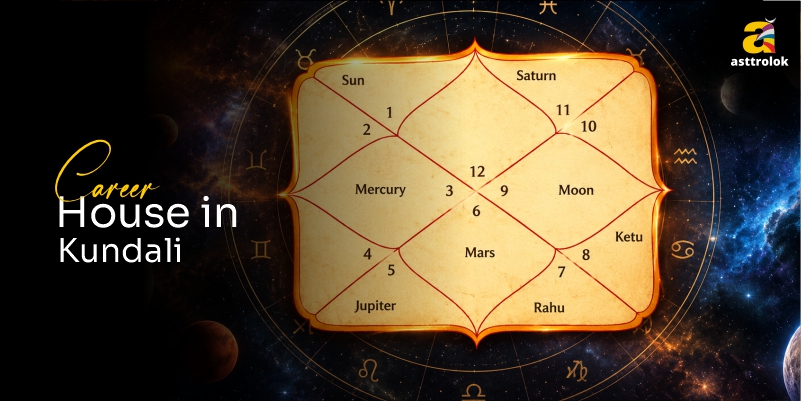
Choosing a career is a significant decision. A student in Indore might be preparing for government examinations, a young professional in Bengaluru may be considering a job change, while a business owner in Delhi could be wondering whether to expand a business. These decisions often lead people to explore career astrology for a different perspective on their professional strengths and challenges.
In Vedic astrology, the 10th house is the primary house of career, profession, work responsibilities and public reputation. However, a complete career prediction by Kundali also considers the 6th house for employment, the 7th house for business, the 2nd house for earnings, the 11th house for gains, and the planets influencing these houses.
Understanding these connections helps an astrologer examine professional possibilities without relying on a single placement.
What Does the 10th House Represent in Kundali?
The 10th house, known as Karma Bhava, is the main career house in Vedic astrology. It represents the work a person performs, responsibilities they undertake, professional recognition, authority and their contribution to society.
For example, a strong and well-supported 10th house may be interpreted as an indication of professional responsibility or opportunities for leadership. Depending on the complete chart, it may relate to management, administration, entrepreneurship or other fields.
However, the 10th house does not independently identify one perfect profession. Its sign, lord, planetary influences and connections with other houses must be examined together.
Why Is the 10th House Important for Career Growth?
When analysing the 10th house and profession, an astrologer generally examines:
10th house sign: Its characteristics provide context for interpreting professional tendencies.
10th house lord: Its placement, strength and associations help assess career themes.
Planets in the 10th house: Their traditional meanings influence the interpretation.
Connections with other houses: Links with the 2nd, 6th, 7th and 11th houses provide additional context.
The same planetary placement can produce different interpretations in different birth charts. That is why career astrology requires a complete chart analysis rather than a fixed formula.
Which Other Houses Indicate Career in Vedic Astrology?
Although the 10th house is the primary professional house, several other houses help explain how a person may work, earn and progress.
1. Sixth House: Job and Employment
The 6th house is associated with service, daily responsibilities, workplace routines, competition and the ability to manage challenges. It is particularly relevant when analysing salaried employment, workplace conditions and competitive examinations.
For instance, when examining a person preparing for a government job, an astrologer may consider the 6th house alongside the 10th house, the Sun and relevant planetary periods.
The difference between the 6th and 10th houses for career is straightforward: the 6th house concerns service and day-to-day duties, while the 10th house represents profession, responsibilities and public standing.
2. Seventh House: Business and Partnerships
The 7th house is important when examining business, entrepreneurship, clients, contracts and professional partnerships.
Suppose someone is deciding between a private-sector job and starting a consultancy. The 7th house may help an astrologer explore themes involving independent work and partnerships, while the 10th house provides the broader professional context.
Neither house alone can confirm business success or determine whether a person should leave employment.
3. Second House: Income and Financial Resources
The 2nd house relates to accumulated wealth, family resources, speech and financial stability. In career analysis, it provides context for earnings and the resources a person builds through professional activity.
For example, an astrologer studying a person's financial progress may examine the relationship between the 2nd house and the 10th house to understand traditional indications concerning profession and accumulated wealth.
4. Eleventh House: Gains and Professional Growth
The 11th house represents gains, fulfilment of ambitions, networks and benefits received through different activities.
When assessing salary growth, professional opportunities or recognition, an astrologer may study the 11th house alongside the 10th house and its lord.
The 2nd, 10th and 11th house career combination is therefore useful in traditional interpretation: the 10th relates to professional activity, the 2nd to accumulated resources, and the 11th to gains.
Read: Which House Represents Wealth in Kundali?
Which Planets Are Responsible for Career in Kundali?
There is no single planet responsible for every person's career. The relevant planets depend on the ascendant, house lordships, planetary placements and the overall birth chart.
Common career significators in Vedic astrology include:
Sun: Traditionally associated with authority, leadership, administration and government-related responsibilities.
Saturn: Associated with discipline, persistence, structured work and long-term responsibilities.
Mercury: Linked with communication, commerce, calculation, analysis and business.
Jupiter: Associated with teaching, knowledge, guidance, ethics and advisory roles.
Mars: Traditionally linked with engineering, technical work, courage and action.
Venus: Associated with creativity, design, aesthetics and certain commercial fields.
These are broad traditional associations, not fixed career rules. For instance, Mercury does not automatically make someone a successful entrepreneur, and Saturn does not necessarily mean a delayed career.
An astrologer must assess the planet's condition, house placement, aspects, relationships with the 10th house and the timing indicated by planetary periods.
How to Read Career from Kundali: A Practical Approach
A structured analysis is more useful than interpreting isolated placements.
Step 1: Examine the 10th house. Identify its sign, occupants and planetary influences to establish the main professional themes.
Step 2: Study the 10th house lord. Assess its placement, strength and connections with other houses. Its relationship with the 6th, 7th or 11th house may add context to employment, business or professional gains.
Step 3: Analyse the 6th and 7th houses. These help explore service, competition, independent work and partnerships.
Step 4: Assess income houses. Examine the 2nd and 11th houses for traditional indications relating to earnings and gains.
Step 5: Review planetary periods and transits. Dashas and transits are used in Vedic astrology to assess timing. They should not be treated as guarantees of a job, promotion or career change.
Step 6: Study the D10 chart. The Dashamsha chart provides another layer of professional interpretation.
Learning this process systematically can help aspiring astrologers develop a more balanced approach to career readings. At Asttrolok, founded by Mr. Alok Khandelwal ji, learners can explore astrology through structured study and practical learning. Those wishing to strengthen their foundations can explore online astrology classes and build their understanding of chart interpretation step by step.
What Is the D10 Chart in Career Astrology?
The D10 chart, also called the Dashamsha chart, is a divisional chart used in Vedic astrology to examine professional life, responsibilities, recognition and career-related themes in greater detail.
When conducting career prediction using D10, astrologers generally consider the D10 ascendant, its lord, the 10th house and its lord, planetary placements, and their relationship with the birth chart.
The D10 chart should not be interpreted in isolation. The main birth chart remains essential, and accurate birth details matter because divisional charts can be sensitive to birth-time differences.
For a more individualised reading, a person may seek an online consultation or review a personalized Kundali to understand how the different chart factors are interpreted together.
Why Choose Asttrolok for Your Astrology Journey?
If you want to understand your career through Kundali or develop your own astrology skills, learning from a structured educational platform can help you approach the subject with greater clarity.
Asttrolok offers astrology education and consultation services for learners at different stages. Under the guidance of founder Mr. Alok Khandelwal ji, the institute focuses on making traditional astrological knowledge accessible to learners.
For aspiring astrologers, structured lessons can help build a foundation in houses, planets, planetary periods and divisional charts. For people seeking career guidance, an individual chart reading can offer a traditional astrological perspective to consider alongside practical factors such as qualifications, interests, experience and financial circumstances.
The goal should be informed reflection, not dependence on a prediction. Your skills, decisions and consistent efforts remain important parts of your professional journey.
Read: What Is Panchang? A Beginner's Guide to Hindu Astrology
Bonus Tips for Understanding Career Astrology
Never judge a career solely by one planet or house.
Verify birth details before interpreting the D10 chart.
Consider education, interests, skills and real-world opportunities alongside astrological interpretations.
Avoid making major career decisions solely on the basis of a horoscope.
Remember that different Vedic astrology traditions may use different interpretative approaches.
कुंडली में दशम भाव व्यक्ति के कर्म, कार्यक्षेत्र और सामाजिक प्रतिष्ठा से जुड़ा माना जाता है। लेकिन सही करियर दिशा समझने के लिए केवल दशम भाव देखना पर्याप्त नहीं है। लग्न, दशमेश, षष्ठ भाव, सप्तम भाव और ग्रहों की दशाओं का भी अध्ययन किया जाता है।
ज्योतिष को आत्मचिंतन और मार्गदर्शन का एक माध्यम मानना बेहतर है। अपनी रुचि, योग्यता, अनुभव और मेहनत को ध्यान में रखकर लिए गए निर्णय आपके भविष्य को अधिक व्यावहारिक दिशा दे सकते हैं।
Conclusion
So, which house represents career in Kundali? The 10th house is the primary house of profession and professional responsibilities, but a meaningful interpretation also considers the 6th, 7th, 2nd and 11th houses, the relevant planets and the D10 chart.
Whether you are exploring a government job, considering a business or trying to understand your professional direction, a complete chart analysis is more informative than focusing on one placement.
Asttrolok Institute, founded by Mr. Alok Khandelwal ji, provides opportunities to learn Vedic astrology and explore traditional chart interpretation. With the right knowledge, a thoughtful approach and practical planning, astrology can become one perspective to consider while shaping your career journey.
Frequently Asked Questions
1. Which house represents career in Kundali?
The 10th house represents career, profession, responsibilities and public reputation in Vedic astrology. It is known as Karma Bhava. Astrologers also examine the 10th house lord, planetary influences, the 6th and 7th houses, income-related houses and the D10 chart to develop a broader interpretation of professional possibilities.
2. Which house represents job in Kundali?
The 6th house is traditionally associated with employment, service, daily duties and workplace challenges. The 10th house represents profession and professional responsibilities. Astrologers examine both houses, their lords and relevant planetary periods when interpreting employment-related questions. These placements do not guarantee a particular job or selection outcome.
3. Which house represents business in Kundali?
The 7th house is commonly examined for business, partnerships, clients and commercial relationships. The 10th house provides information about profession, while the 2nd and 11th houses relate to financial resources and gains. A traditional business astrology reading considers these houses together rather than using one placement to guarantee entrepreneurial success.
4. Which planet is responsible for career in Vedic astrology?
No single planet determines everyone's career. The Sun is associated with authority, Saturn with discipline, Mercury with communication and commerce, and Jupiter with knowledge and guidance. Mars and Venus can also be relevant, depending on the chart. Their house placements, lordships, strength and connections must be considered before interpreting professional themes.
5. How can I check my career in Kundali?
Begin by examining the 10th house and its lord, then study the 6th house for employment, the 7th for business, and the 2nd and 11th for earnings and gains. Review the relevant planets, dashas and D10 chart as well. Accurate birth details and practical considerations are important for a balanced assessment.
Comments (0)
.webp)
Categories
Recent posts

भाग्यांक कैसे ...
30 Aug 2023
Importance of Bhakoot Koota in Kundali ...
30 Aug 2023