Astrology
 Ayurveda
 Palmistry
 Vastu
Views: 16
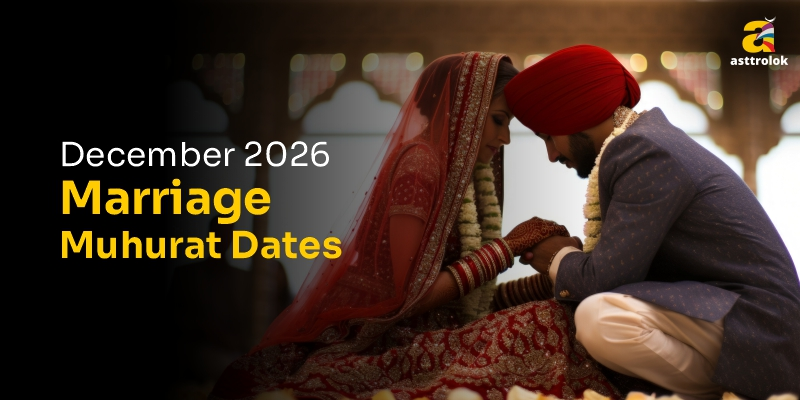
A winter wedding has a special charm in India. Families begin discussing the venue, guest list, outfits and celebrations months in advance. But before booking the mandap or sending invitations, one important question usually comes up: December 2026 mein shadi ke shubh muhurat kab hain?
In Hindu tradition, marriage is not simply a social celebration. It is considered a sacred sanskar in which two people begin a shared journey with the blessings of family and the divine. This is why many families consult the Panchang before finalising a wedding date.
The December 2026 Marriage Muhurat calendar offers a few suitable dates in the first half of the month. The second half falls during Kharmas, a period when many Hindu traditions avoid conducting weddings. Let us look at the dates, the astrological factors behind them and the checks couples should make before confirming a wedding.
December 2026 Marriage Muhurat: Auspicious Wedding Dates
Based on published Panchang calculations, the main wedding dates fall between 2 and 12 December 2026. The table below gives a useful planning overview. The timings are indicative and can differ by city, sunrise calculation and Panchang tradition.
Important: These are not universal wedding timings. For example, an Indore-based Panchang calculation gives 2 December as 10:52 PM to 6:52 AM the following day, while other calendars show slightly different timings. Before booking your ceremony, confirm the exact local lagna and muhurat with a qualified astrologer or family priest. Do not treat a date alone as a complete wedding muhurat.
Check Bodhlok vedic astrology software
Which Are the Best Dates for Marriage in December 2026?
The suitable date depends on the couple's Kundli, family customs, venue arrangements and the actual time selected for the wedding rituals.
2 and 3 December: Uttara Phalguni Nakshatra
Uttara Phalguni is traditionally associated with commitments, agreements and supportive relationships. It is therefore included among the nakshatras considered for marriage in many Panchang traditions. The muhurat may extend across the night from 2 to 3 December, so the ceremony date should be understood according to the selected ritual time and local Panchang.
4 December: Hasta Nakshatra
Hasta is associated with skill, careful work and the ability to build something through effort. Some December 2026 calculations list a morning wedding window on this date. Couples considering this option should check the exact tithi and lagna before confirming their ceremony schedule.
5 and 6 December: Swati Nakshatra
Swati is often linked with independence, movement and adaptability. These qualities can be meaningful when two individuals are preparing to build a life together while respecting each other's individuality. The available windows differ between the two dates, so the wedding ritual should be timed carefully.
11 and 12 December: Uttara Ashadha Nakshatra
Uttara Ashadha is traditionally associated with determination, responsibility and lasting effort. It appears in several December wedding calendars. Some of the available windows begin late at night on 11 December and continue into the morning of 12 December.
Read: December 2026 Shubh Muhurat: Best Auspicious Dates & Calendar
Why Does Kharmas Matter for December 2026 Weddings?
Kharmas is a period observed in several Hindu traditions when auspicious ceremonies such as weddings are generally avoided. In December 2026, the Sun enters Sagittarius on 16 December, marking the beginning of Dhanu Sankranti and the Kharmas period according to the commonly followed North Indian convention.
For this reason, the main December 2026 wedding window is concentrated in the first half of the month. Many families wait until Kharmas ends before scheduling marriage ceremonies again. The exact resumption of wedding muhurats should be checked with the relevant January 2027 Panchang.
It is worth remembering that customs can vary across regions and communities. If your family follows a particular regional calendar, consult the priest or astrologer who follows that tradition rather than relying on a general online list.
How Is a Hindu Marriage Muhurat Selected?
A wedding muhurat is selected by studying several Panchang and horoscope factors together. A date may appear auspicious in a general calendar, but the final ceremony time needs a more individual assessment.
Tithi: The lunar day is checked to identify whether it is considered suitable for marriage according to the family's Panchang tradition.
Nakshatra: The Moon's nakshatra is examined. Rohini, Mrigashira, Magha, Uttara Phalguni, Hasta, Swati, Anuradha, Mula, Uttara Ashadha, Uttara Bhadrapada and Revati are among the stars traditionally considered for marriage in various systems.
Marriage Lagna: The ascendant at the time of the ceremony is assessed. A suitable lagna is selected while considering the placement and condition of relevant planets.
Kundli Matching: The birth charts of both individuals are studied. Guna Milan may be considered along with other horoscope factors, including the seventh house, Venus, Jupiter and relevant dashas.
Chandra Bal and Tara Bal: These are checked to understand the Moon's and nakshatra's suitability for the individuals concerned.
Dosha and planetary conditions: Factors such as Guru or Shukra Asta, Rahu Kaal and other restrictions followed by the family's tradition may also be examined.
This is why the December 2026 Marriage Muhurat should be finalised after individual horoscope assessment rather than by selecting the first available date on a calendar.
Why Is Kundli Matching Important Before Marriage?
Kundli matching is a traditional method of examining the astrological compatibility of two people. Ashtakoota Guna Milan is one commonly used system, but it is not the only consideration.
An astrologer may also examine the seventh house, the condition of its lord, Venus, Jupiter, the Moon and the running planetary periods. These factors are interpreted together to understand traditional indicators connected with partnership, emotional compatibility and shared responsibilities.
Astrology should be approached as a guidance system, not as a substitute for communication, mutual respect or personal choice. A healthy marriage also depends on how two people understand and support each other.
शुभ मुहूर्त Calculation के लिए Free Jyotish Software | Marriage Muhurta Calculation software | Hindi -
Couples who want to understand their charts can explore a personalized Kundali assessment, while those seeking a detailed discussion may consider an online consultation with an astrologer.
How Asttrolok Helps You Understand Marriage Astrology
Choosing a wedding muhurat can also be an opportunity to learn why particular dates, nakshatras and planetary combinations matter. At Asttrolok Institute, astrology is approached as a subject that can be studied with structure, clarity and practical understanding.
Founded by Mr. Alok Khandelwal ji, Asttrolok supports people who want to deepen their knowledge of Vedic astrology, whether they are beginners, serious learners or practising astrologers. Its learning programmes can help students build a stronger foundation in concepts such as Kundli reading, planetary placements, dashas and muhurat selection.
Those who wish to develop their knowledge can explore the institute's online astrology classes. Learning astrology can be useful for people who want to pursue it as a career, improve their chart-reading skills or understand traditional astrological principles more confidently. For personal marriage-related questions, an individual consultation is more appropriate than relying only on general predictions.
Bonus Tips Before Finalising Your December Wedding
Confirm the city: Panchang timings are location-sensitive. A muhurat calculated for Delhi may not be identical to one for Indore, Mumbai or Jaipur.
Check the actual ritual time: The time of the pheras or the main marriage sankalp may matter more than the time printed on the invitation.
Match both Kundlis: Do not select a date only because it appears in a general wedding calendar.
Speak to your family priest early: This gives you time to coordinate the date, lagna and traditional customs.
Plan winter arrangements: December evenings can be cold in many parts of India. Arrange covered seating, heating and comfortable facilities for elderly guests.
Keep a practical backup: Venue availability, travel and family schedules matter too. Finalise the date only after the astrological and practical checks are complete.
दिसंबर 2026 में विवाह की योजना बना रहे परिवारों के लिए सबसे जरूरी बात यह है कि केवल शुभ तारीख देखकर निर्णय न लें। विवाह का वास्तविक मुहूर्त तिथि, नक्षत्र, लग्न और वर-वधू की कुंडली को ध्यान में रखकर तय किया जाता है। सही मार्गदर्शन से परिवार अपनी परंपराओं का सम्मान करते हुए तैयारी को सहज बना सकते हैं।
शुभ विवाह का अर्थ केवल एक शुभ घड़ी चुनना नहीं, बल्कि आपसी विश्वास, समझ और जिम्मेदारी के साथ नए जीवन की शुरुआत करना भी है।

Visit - Bodhlok.com
Conclusion
The December 2026 Wedding Dates are mainly concentrated in the first half of the month, before Kharmas begins around 16 December. Dates such as 2, 3, 4, 5, 6, 11 and 12 December appear in several published marriage calendars, but the final muhurat must be confirmed for the wedding location and both birth charts.
Take time to understand the Panchang instead of rushing into a date selection. Asttrolok Institute, under the guidance of founder Mr. Alok Khandelwal ji, offers a learning environment for people interested in Vedic astrology, professional development and deeper astrological understanding. Explore the institute to take your interest in astrology further and make informed decisions with the right guidance.
Frequently Asked Questions
1. What are the marriage muhurat dates in December 2026?
Several published Panchang calendars list 2, 3, 4, 5, 6, 11 and 12 December as possible wedding dates. Some calendars include additional dates or different time windows because their calculation methods and locations vary. Confirm the final date and lagna with a qualified astrologer before making wedding arrangements.
2. Is December 2026 a good month for marriage?
Yes, the first half of December 2026 has several dates listed for Hindu weddings in published Panchang calendars. The second half falls during Kharmas, when many families traditionally avoid marriage ceremonies. Whether a particular date is suitable depends on the couple's Kundlis, local Panchang and family customs.
3. When does Kharmas start in December 2026?
Kharmas is generally considered to begin on 16 December 2026, when the Sun enters Sagittarius, marking Dhanu Sankranti. Many North Indian families avoid weddings during this period. Regional traditions and calendars may differ, so check the practice followed by your family.
4. Which Nakshatras are auspicious for marriage?
Nakshatras commonly considered for marriage include Rohini, Mrigashira, Magha, Uttara Phalguni, Hasta, Swati, Anuradha, Mula, Uttara Ashadha, Uttara Bhadrapada and Revati. Their suitability is assessed alongside tithi, weekday, lagna and the couple's birth charts. No nakshatra should be considered in isolation.
5. Why is Kundli matching important before marriage?
Kundli matching is traditionally used to assess astrological compatibility between two individuals. It may include Guna Milan, examination of the seventh house, planetary placements and running dashas. It offers a traditional perspective, but a successful marriage also needs trust, communication, mutual respect and shared understanding.
6. How is the marriage lagna calculated?
Marriage lagna is calculated using the local date, time and place of the wedding. An astrologer studies the rising sign, planetary placements, relevant houses and the Panchang to identify a suitable period for the main ceremony. The selected time can vary between cities because sunrise and the ascendant change with location.
Comments (0)
.webp)
Categories
Recent posts
भाग्यांक कैसे ...
30 Aug 2023
Importance of Bhakoot Koota in Kundali ...
30 Aug 2023